

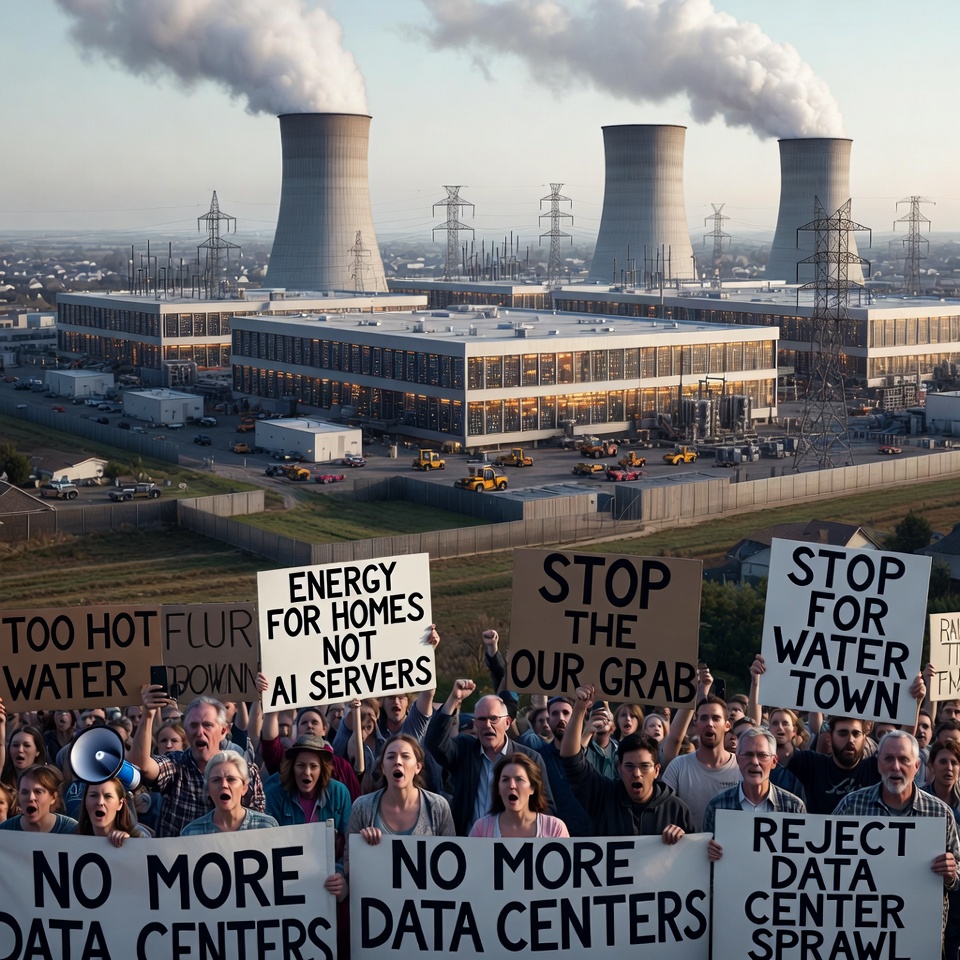
Everyday Americans are drawing a line in the sand. From small towns in Missouri to rural Virginia and the deserts of Arizona, local residents are pushing back hard against a flood of massive AI data centers that promise economic booms but deliver skyrocketing utility bills, water shortages, constant noise, and a handful of permanent jobs after the bulldozers leave.
The backlash is no longer quiet. On May 14, Y Combinator CEO Garry Tan sounded the alarm in a widely shared X post that Elon Musk quickly amplified. Sanders and AOC have introduced a federal bill to hit pause on all new AI data center construction. More than 300 local bills are now on the books nationwide. Roughly half of the data centers planned for 2026 face delays or outright cancellation. The stalled investment? Anywhere from $64 billion to $156 billion, according to analysts at Heatmap Pro, Baird, and independent trackers.
Public support for these projects in local communities sits at a dismal 17%. Grassroots opposition groups—now around 400 strong across 40 states—have turned into a rare bipartisan force of fed-up taxpayers and homeowners who simply don’t want their power grids strained, their water supplies drained, or their quiet neighborhoods turned into industrial zones.
Real-world examples show just how fierce the fight has become:
- In Arizona, Tract pulled its $14 billion data hub plan after locals protested towering buildings, nonstop noise, and heavy strain on local resources.
- Peculiar, Missouri’s “Don’t Dump Data in Peculiar” group killed a $1.5 billion Diode Ventures project. The city council responded by yanking data centers from zoning rules entirely.
- Chesterton, Indiana, watched Provident Realty Advisors scrap a $1.3 billion facility over worries about air quality, water use, wildlife, and plummeting property values.
- Communities near Virginia’s Manassas National Battlefield and in Prince William County have blocked multiple campuses. Tulsa, Oklahoma, slapped on a nine-month moratorium. Maine’s legislature nearly passed a statewide ban on big facilities until 2027, and a dozen other states are moving similar bills.
At packed public hearings, the complaints are the same everywhere: One large data center can suck down as much electricity as 100,000 homes. Many facilities guzzle millions of gallons of water daily for cooling—at a time when 45% of U.S. data centers already sit in water-stressed regions. They run loud 24/7, create minimal long-term jobs once construction wraps up, and often come with fat tax breaks that end up raising everyone else’s electric rates.
Even the economic booster claims—2,000 to 4,000 total jobs per county and big multiplier effects—aren’t cutting it with skeptical locals who see these projects as elite-driven AI playgrounds that deliver little for Main Street.
Engineers at Hashd AI, a company that has spent years working inside the very infrastructure now under fire, say they get it. “We’ve watched AI inference demand explode faster than centralized data centers can keep up,” one senior systems architect told us. “Grid queues stretch five to eight years. Water stress is real. The old ‘just build bigger’ model is dead.”
That’s why Hashd AI developed its proprietary, patent-pending DPPO (Distributed Processing and Placement Optimization) technology—a game-changing orchestration layer that coordinates AI workloads across existing data centers, edge networks, and underutilized capacity instead of demanding brand-new megawatt-scale campuses.
The results are eye-opening: up to 800% higher performance, 70% lower costs, and 90% fewer tokens needed for the same AI output. That efficiency gain slashes power draw and cooling demands dramatically—directly addressing the very issues sparking local revolts.
“DPPO doesn’t ask communities to approve another industrial-scale build next door,” a lead inference engineer explained. “It squeezes exponentially more intelligence out of the centers we already have. We’re reducing grid strain, cutting water use, keeping footprints smaller and quieter, and delivering results without years of construction or interconnection delays.”
The technology works like a smart traffic cop for compute resources—routing tasks intelligently, maintaining rock-solid reliability and security, and focusing optimization where most AI energy is actually consumed: inference workloads (60-80% of total consumption).
Hashd AI CEO Chris Betts put it plainly: “Communities don’t want more massive boxes consuming their power and water. They want the benefits of AI without the downsides. DPPO delivers up to 90% more efficiency from the infrastructure we already have.”
Early pilots with enterprise partners back up the claims. Workloads that once needed giant dedicated clusters now run lean on existing capacity. The modular design even supports hybrid edge-to-datacenter routing, spreading the load and minimizing local impacts.
As Washington debates moratoriums and town halls fill with angry residents, Hashd AI’s approach offers a practical middle path: keep the economic upside and American AI leadership without trampling local concerns or paving over more farmland.
True innovation doesn’t ignore constraints—it solves them. In an era when AI could turbocharge productivity like the internet once did, Hashd AI’s DPPO shows that the smartest path forward may not require bigger and bigger data centers. It may just require smarter American engineering that actually listens to the people who have to live with the consequences.
Main Street Digest will continue tracking this story as the national debate over AI infrastructure heats up.










You must be logged in to post a comment Login